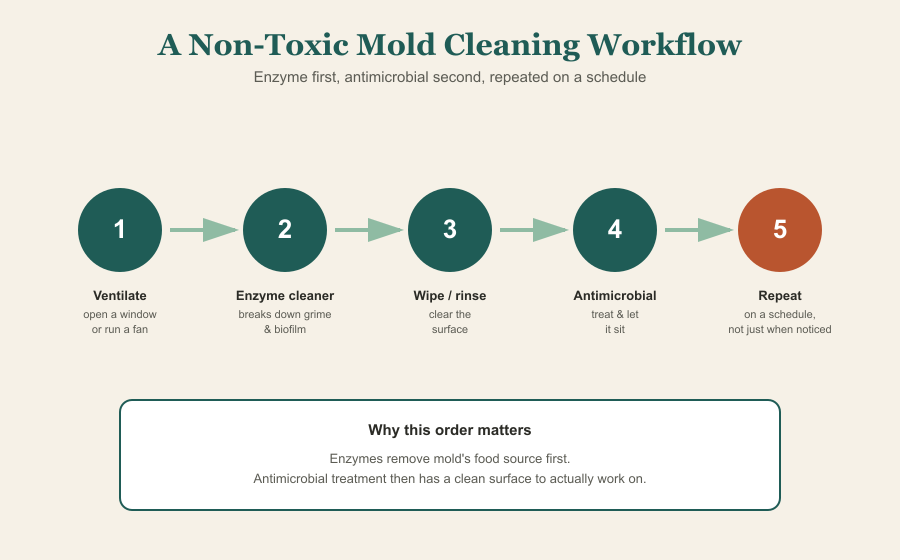
Search “how to clean mold” and you’ll get a wall of conflicting advice — bleach, vinegar, baking soda, hydrogen peroxide, tea tree oil, borax. Some of it is genuinely useful. A lot of it is half-true or actively counterproductive. Here’s a clearer breakdown of what’s actually happening when you clean mold, and where non-toxic products fit in.
Why bleach isn’t the slam dunk people think it is
Bleach is the most commonly reached-for mold “solution,” and it does kill surface mold on non-porous materials like tile and glass. The problem is porous surfaces — drywall, grout, wood, caulk. Bleach’s chlorine can’t penetrate deep enough to reach mold growing inside these materials, so it bleaches the visible color without killing the root structure. Worse, the water content in bleach can actually feed the mold that survives beneath the surface, and the fumes are genuinely harsh to breathe, especially in a small bathroom with poor ventilation.
Bleach isn’t “wrong,” exactly — it has a place on hard, non-porous surfaces in a pinch. It’s just not the thorough or safe solution people assume it is.
What about vinegar?
White vinegar is mildly acidic and can kill some mold species on some surfaces, which is why it’s a popular natural remedy. But its effectiveness varies a lot depending on the type of mold and the surface, and it doesn’t have meaningful residual (ongoing) antimicrobial effect once it dries. It’s a reasonable low-cost option for very light, surface-level spots — not a substitute for a targeted product when you’re dealing with a real problem area.
What you actually want from a mold cleaner
A genuinely effective, lower-toxicity mold cleaner should:
- Penetrate porous surfaces, not just bleach the visible color
- Have some residual protection, so it’s not just a one-time kill
- Be safe to use without heavy ventilation gear in bathrooms, closets, and bedrooms
- Not leave a chemical smell that lingers for days
This is the gap that enzyme- and essential-oil-based cleaners try to fill. Micro Balance’s EC3 Mold Solution Concentrate uses a blend of grapefruit seed extract and other plant-based antimicrobial compounds, and is formulated to be used on porous and non-porous household surfaces alike. For smaller, ready-to-use jobs — window sills, shower caulk, closet corners — their EC3 Mold Solution Spray is the pre-mixed version of the same idea, and their EC3 Wipes are a convenient option for quick touch-ups on doorknobs, faucet handles, and other high-touch surfaces.
Don’t skip the enzyme step for organic buildup
Mold doesn’t grow in isolation — it usually shows up alongside soap scum, biofilm, and general organic grime, especially in bathrooms and around window tracks. An enzyme cleaner breaks down that organic buildup itself, which removes the food source mold needs to keep coming back. EC3 Enzyme Cleaner Concentrate is designed as a companion step for exactly this — pairing an antimicrobial treatment with an enzyme-based degreaser tends to outperform either one used alone.
When cleaning isn’t enough
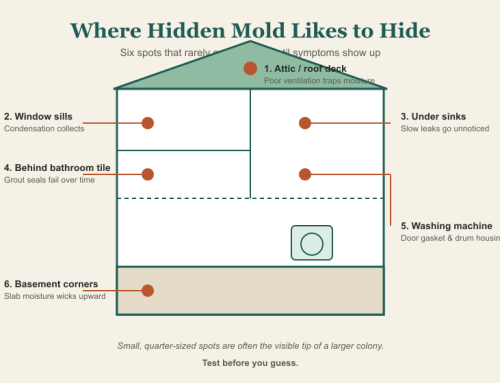
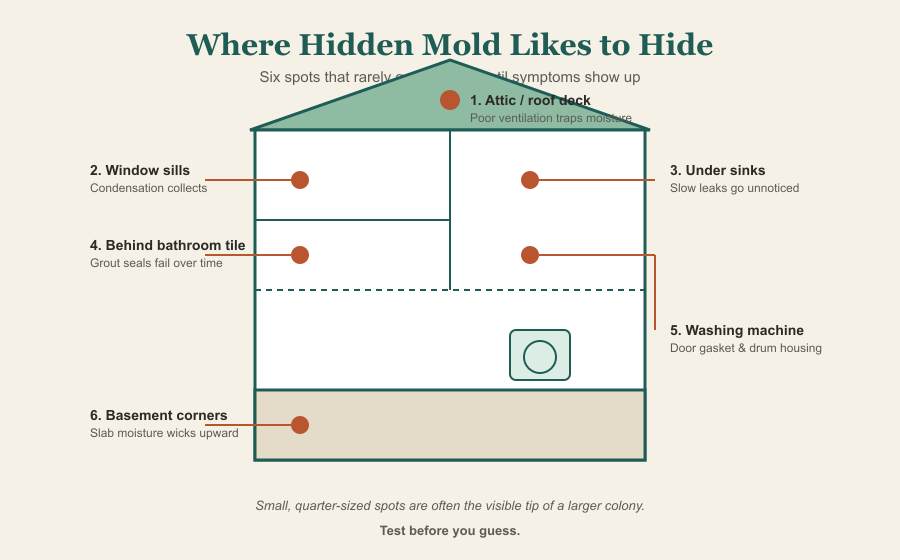
It’s worth being honest here: no cleaning product, natural or otherwise, fixes an underlying moisture problem. If mold keeps returning to the same spot within a few weeks of cleaning it, the real issue is a leak, condensation, or poor ventilation that needs to be addressed at the source. Cleaning products manage what’s already there — they can’t compensate for a wall that stays wet. You can browse the full cleaning lineup here to put together a routine that fits your specific problem areas.
Frequently Asked Questions
Is it ever safe to mix bleach with vinegar or other cleaners? No — this is worth stating plainly. Mixing bleach with vinegar, ammonia, or many other household cleaners can produce toxic chlorine or chloramine gas, which is a genuine safety hazard, not a theoretical one. Stick to one product at a time, rinse surfaces between different cleaners, and always ventilate the space you’re working in.
How long should I let a mold cleaner sit before wiping it off? This varies by product, so the label instructions are the most reliable answer. As a general pattern, antimicrobial sprays typically need several minutes of contact time to be effective — wiping immediately after applying often means you’re not giving the product time to actually work.
Is bleach ever the right choice? On small areas of hard, non-porous surfaces like glazed tile or glass, and when you specifically want visible discoloration removed quickly, bleach can be a reasonable option. It’s just not a thorough solution for porous materials or for actually killing mold at the root, and the fumes warrant real ventilation.
How do I know if a spot needs professional remediation instead of DIY cleaning? A commonly cited guideline (used by the EPA, among others) is that mold-affected areas larger than about 10 square feet — roughly a 3-by-3-foot patch — are generally better handled by a remediation professional, both because of the physical scope of the work and the risk of spreading spores further by disturbing a large colony without containment. Smaller, contained spots are more reasonable to handle yourself with proper cleaning products and ventilation.
Do essential-oil-based cleaners smell strong, and is that a problem for sensitive people? Plant-based cleaners using grapefruit seed extract or tea tree oil do have a noticeable scent, though it’s generally milder and less harsh than bleach or ammonia-based products. If you or someone in your home is sensitive to strong scents, it’s worth testing a small amount first and ventilating well during use, regardless of which cleaner you choose.